
The GLP-1 Era
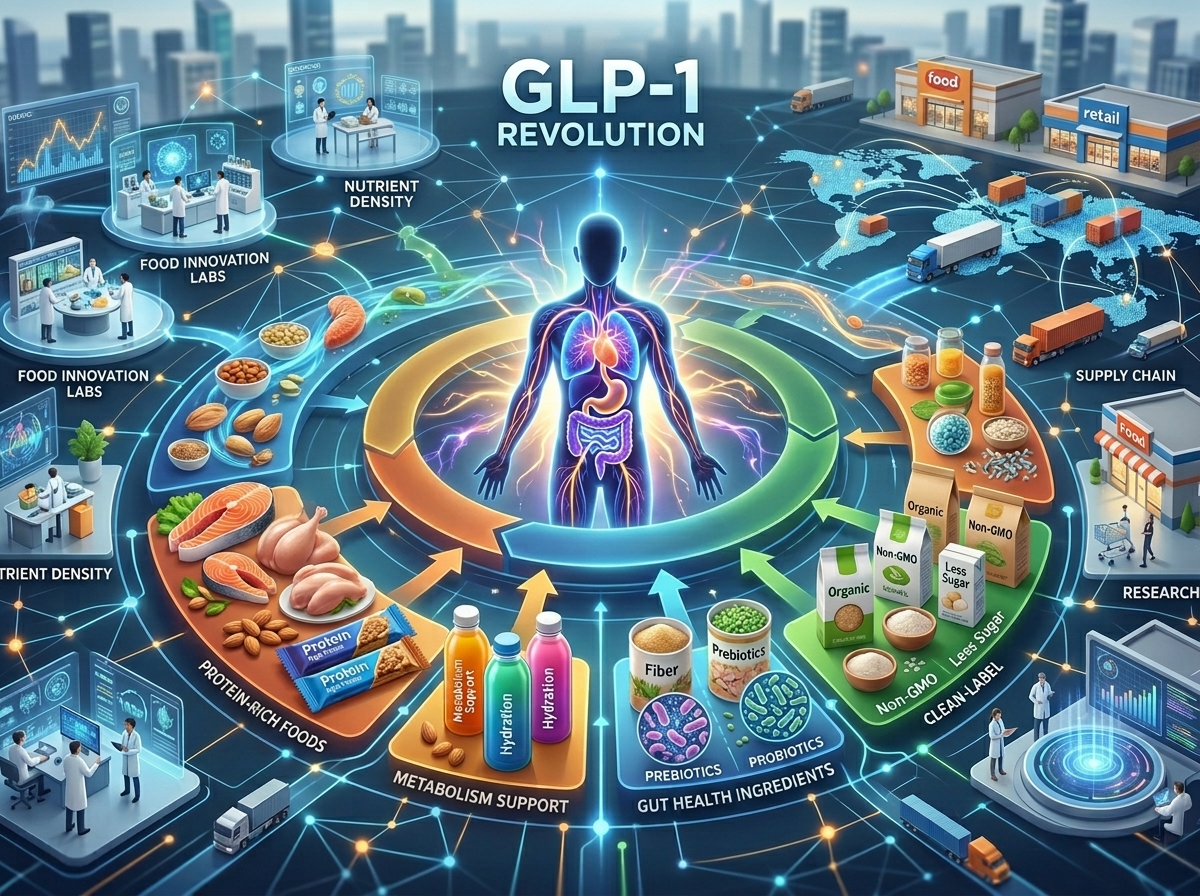
How to Transform a Metabolic Revolution into Strategic Opportunity for the B2B Food Ingredients Industry
A paradigm shift is currently sweeping through the food and beverage industry, catalyzed by a class of medications originally designed to treat diabetes: GLP-1 agonists (Glucagon-Like Peptide-1). Molecules such as semaglutide (Ozempic, Wegovy) and tirzepatide (Mounjaro) are no longer confined to medical discourse; they are actively redefining consumption behaviors at a global scale. With over 13 million Americans already under treatment and adoption growing exponentially, the impact on food choices, satiety, and taste preferences is profound and lasting [10].
For OliveTree Partners’ clients (innovators in B2B food ingredients, biotechnology, and agritech) this wave should not be perceived as a threat, but as a major strategic opportunity. This report aims to decipher the dynamics of this emerging market and provide concrete action paths, aligned with OliveTree Partners’ expertise in sustainable growth strategy, leadership, and transformation.
Going Deeper: Why This Wave Is Different
What separates GLP-1 adoption from previous health and wellness trends is its pharmacological permanence. Unlike dietary fads driven by cultural cycles, these molecules rewire the physiological architecture of hunger itself. They act on GLP-1 receptors in the hypothalamus and the gut simultaneously — suppressing appetite centrally, slowing gastric emptying peripherally, and blunting the dopaminergic reward response to food. The result is not willpower. It is biology.
This matters enormously for food manufacturers: behavioral changes driven by physiology, not intention, are far more durable and predictable than those driven by consumer sentiment. GLP-1 adoption is not a trend to be monitored — it is a structural reset of the consumer-food relationship that warrants a proportional strategic response.
Europe is accelerating. The EMA’s conditional approval of semaglutide for weight management, combined with expanding NHS reimbursement discussions in the UK and German statutory insurer pilots, signals that the 13-million-user figure in the US is a floor, not a ceiling for global adoption. Industry analysts at Morgan Stanley project over 24 million GLP-1 users in the US alone by 2030. The pipeline of new molecules — oral GLP-1 agonists, triple agonists, combination therapies — will further lower the barrier to treatment and compress the adoption curve dramatically.
This is not a trend. It is a permanent alteration of the consumer-food relationship — one that will deepen with every new prescription written.
The GLP-1 Revolution: AnatomThe GLP-1 Revolution: Anatomy of a New Consumer
GLP-1 medications fundamentally alter the consumer’s relationship with food. By regulating appetite and increasing satiety, they transform the act of eating from a quest for volume into a pursuit of quality and functionality. According to research from Tastewise, nearly 70% of GLP-1 users now organize their eating habits around weight management, scrutinizing each product for its nutritional value [10].
This phenomenon has direct implications for manufacturers. The reduction in overall caloric intake pushes consumers to become more intentional in their choices, favoring foods that offer tangible benefits. This trend, termed “mindful eating,” is the new standard to which brands must conform [1].
| GLP-1 Consumer Characteristic | Implication for the Food & Beverage Industry |
|---|---|
| Reduced Appetite | Favors smaller portions and nutrient-dense foods. |
| Increased Satiety | Seeks ingredients that prolong satiety sensation (proteins, fiber). |
| Modified Preferences | Less attraction to fatty and sugary foods; growing interest in complex flavors and “healthy” foods. |
| Health Focus | Desire to associate weight loss with overall wellness (hydration, digestive health, muscle mass). |
Going Deeper: Decoding the GLP-1 Consumer Psychology
The table above maps behavioral outputs. What it does not capture is the underlying psychology driving them — and for ingredient suppliers, that psychology is a precise innovation brief.
GLP-1 users do not simply lose appetite. They undergo a reconfiguration of desire. Research from FoodNavigator [9] documents a consistent pattern: hyper-sweet and hyper-fatty stimuli lose their pull, while preferences shift markedly toward complexity, texture, and what users describe as “foods that feel earned.” This is not restraint. It is a genuine change in hedonic weighting — the brain’s reward circuitry rebalancing around different sensory and functional cues.
For formulators and ingredient suppliers, this psychology translates into a precise set of innovation parameters:
- Flavor complexity over intensity — umami, fermented, aged, and layered aromatic profiles that deliver a rich sensory experience within a smaller portion
- Meaningful texture — contrast and resistance that makes eating feel deliberate and satisfying, not merely functional
- Clean-label legibility — ingredient lists that align with the user’s self-image as an active health manager
- Functional storytelling — products that visibly support the goals the medication is helping them pursue: muscle preservation, digestive comfort, metabolic health
| GLP-1 Consumer Characteristic | Observed Behavior | Precise B2B Ingredient Opportunity |
|---|---|---|
| Reduced appetite | Smaller portions, less frequent eating | Nutrient density; micro-format innovation |
| Enhanced satiety | Reduced snacking, deliberate meal choices | High-quality proteins & fibers that extend fullness signals |
| Modified taste profile | Flight from hyper-sweet/fatty stimuli | Sugar reduction systems; complex aromatic solutions |
| “Earning” food | Preference for clean, functional products | Clean-label ingredients with provenance and sustainability story |
| Health integration | Linking weight loss to total wellness | Gut health, hydration, collagen, muscle-support compounds |
OliveTree Lens
The GLP-1 consumer is not just eating less — they are eating with intention for the first time. Ingredients that speak to that intention, functionally and narratively, will command a premium that commodity ingredients cannot.
Key Trends and Opportunities for B2B Ingredients
Analysis of recent industry publications, particularly from major events like Expo West 2026, reveals several clear growth axes for ingredient suppliers.
1. The Protein Imperative
Demand for protein-enriched products is exploding. Consumers using GLP-1 medications seek to preserve muscle mass despite reduced caloric consumption. This trend is so strong that even snacking giants like Doritos are launching hyper-protein versions of their products [8]. For OliveTree Partners’ clients specializing in bio-ingredients and fermentation, this represents a unique opportunity to position alternative proteins (derived from precision fermentation, legumes, etc.) as solutions of choice — not only for their functionality but also for their sustainability profile.
Going Deeper: The Protein Opportunity in Detail
The logic is physiologically iron-clad: caloric restriction without adequate protein accelerates sarcopenia — the progressive loss of muscle mass that carries serious long-term health consequences including metabolic slowdown, increased fall risk, and insulin resistance. Physicians prescribing GLP-1 medications are explicitly recommending protein supplementation. Their patients are following that advice. And the market is responding at speed.
24-40g
Daily protein gap estimated in GLP-1 users eating below 1,400 kcal/day
The protein opportunity, however, is not homogeneous. There is a clear hierarchy of demand emerging, and ingredient suppliers who understand it can position accordingly:
- Priority #1: Complete amino acid profiles
- Priority #2: Leucine-rich formulations that activate mTOR-mediated muscle protein synthesis — directly addressing the medical imperative
- Priority #3: Clean-label, allergen-free sources that align with the GLP-1 user’s broader health identity (precision fermentation proteins, pea-rice blends, mycoprotein)
- Priority #4: Bioavailability — fast-digesting hydrolysates for post-absorption windows; slow-release caseinate analogs for overnight muscle preservation
What makes this moment particularly valuable for innovative B2B players is the convergence of two simultaneous consumer priorities: functional protein delivery AND a compelling sustainability narrative. GLP-1 users skew toward environmentally aware consumers. They don’t want just any protein — they want protein that aligns with their values. Alternative proteins derived from fermentation or plant-based sources are positioned at precisely this intersection, and that dual-value story is one that mass-commodity protein suppliers cannot credibly replicate.
OliveTree Lens
Clients specializing in precision fermentation and bio-ingredients are not just offering an alternative to whey — they are offering the only protein solution that simultaneously answers the functional AND the values-driven demand of the GLP-1 consumer. That duality is the foundation of a commercially differentiated narrative.
2. Functional Formulation
Formulators are actively seeking ingredients that meet new expectations: sugar reduction, fiber fortification, and increased nutritional density, without compromising taste [13]. Companies such as Givaudan, Kerry, and FrieslandCampina Ingredients have all highlighted their solutions to support this transition, ranging from complex aromas to probiotics that support digestive health in GLP-1 users [3] [4] [7]. This is ideal terrain for OliveTree Partners’ expertise in transforming constraints into competitive advantages.
Going Deeper: The Formulation Briefing Every Supplier Should Know
The formulation challenge facing CPG brands serving GLP-1 users is multi-dimensional and urgent. It is not enough to reduce sugar or add fiber in isolation. The new brief is integrative: every reformulation decision must simultaneously address nutritional function, sensory preservation, and cost-of-goods discipline — without sacrificing any of the three.
There is also a dimension that receives insufficient attention in industry discussions: gut health. GLP-1 medications frequently cause gastrointestinal side effects — nausea, constipation, bloating — particularly in early treatment phases. This creates a specific, medically grounded demand for digestive-support ingredients that goes beyond the general fiber trend. Prebiotic fibers, postbiotics, specific probiotic strains shown to reduce GI discomfort — these are not generic wellness claims. They are targeted solutions to a documented clinical need in a defined and growing consumer population.
The most advanced industry players have already mapped the priority ingredient categories for GLP-1 formulation:
- Next-generation sweetness reduction systems — not just bulk sweetener replacement but full taste-modulation solutions that rebuild the flavor curve lost when sugar is removed
- Prebiotic and postbiotic fibers — soluble, tolerable, with clinical backing on digestive comfort and satiety signaling
- Texture systems for reduced-portion formats — starch modifications, hydrocolloid blends, and protein matrices that maintain satisfying mouthfeel at smaller serving sizes
- Micronutrient premixes — filling the nutritional gaps created by lower total food intake, with bioavailability optimization
- Collagen peptides and joint-support compounds — addressing the muscle and connective tissue preservation agenda of the long-term GLP-1 user
Ardent Mills is developing bakery formulations integrating whole grains and pulses specifically targeting GLP-1 consumer demands[11]. ADM’s 2026 Global Culinary Trends report highlights a broad convergence toward greater complexity and functionality [12]. The direction is unambiguous: the ingredients of tomorrow are those that can prove their functional story — not just claim it.
OliveTree Lens
The single most powerful commercial reframe for ingredient suppliers right now: stop selling ingredients, start selling documented solutions to a precisely defined formulation problem. Every sales conversation should begin not with product specs but with the specific GLP-1 consumer challenge your client’s brand is trying to solve.
3. The Rise of Functional Beverages
The market for beverages specifically designed for GLP-1 users is accelerating rapidly, with forecasts reaching $3.5 billion[5]. Innovation focuses on hydration, protein content, fiber, and collagen. This segment represents a fast-track entry point with significant potential for innovative ingredients.
Going Deeper: Why Beverages Are the Strategic Beachhead
The $3.5 billion projection is not just an attractive number — it is a signal about where structural demand is forming fastest, and why beverages represent a uniquely compelling go-to-market entry point for ingredient suppliers seeking to establish credibility in the GLP-1 space.
$3.5B
Projected market for GLP-1-targeted functional beverages by 2028 — Beverage Daily [5]
Three structural advantages make beverages the strategic beachhead of the GLP-1 opportunity:
- Speed: Product development cycles in beverages are 40-60% shorter than in solid food categories. A formulation brief can become a retail-ready SKU in 9-12 months, compared to 18-24 months in bakery or snacking.
- Accessibility: Regulatory barriers for beverage claims are often more navigable than for food. The functional beverage category has an established consumer language — hydration, recovery, energy, focus — that maps naturally onto GLP-1 user needs.
- Proof of concept: A co-developed beverage innovation with a pilot client brand is the fastest way to generate the commercial case study, consumer data, and market validation needed to scale into more complex and higher-margin food categories.
The innovation architecture in GLP-1 beverages is converging around a recognizable profile: 15-25g protein per serving, 5-10g prebiotic fiber, electrolyte optimization for users experiencing fluid retention changes, and clean-label collagen. The RTD (ready-to-drink) format dominates current launches, but powder-format products targeting the home preparation ritual of health-conscious GLP-1 users are emerging as a high-growth adjacent segment.
OliveTree Lens
For ingredient suppliers without existing beverage-sector relationships, this is the moment to build them. The brands launching GLP-1 beverages today are early movers in a category that will be mainstream within 24 months. Being their foundational ingredient partner now creates supply chain entrenchment that will be very difficult for competitors to displace later.
Strategic Recommendations for OliveTree Partners’ Clients
Faced with this mutation, a wait-and-see approach is not an option. Strategic action is imperative. Drawing on OliveTree Partners’ 360° analysis, here are concrete recommendations:
1. Align Innovation with GLP-1 Demand
R&D efforts must be oriented toward developing ingredients that directly address identified needs: high-quality proteins, prebiotic fibers, sugar-reduction solutions, and ingredients promoting satiety. OliveTree’s expertise in agile innovation strategies is a major asset here.
Going Deeper: How to Audit Your Innovation Pipeline Right Now
The first step is a structured portfolio audit through the GLP-1 lens. Categorize every ingredient in your active pipeline and commercial portfolio against five criteria: protein functionality, fiber/prebiotic value, satiety contribution, sugar-reduction capability, and gut-health support. This mapping will reveal, in most cases, that 60-70% of your existing assets have direct relevance to the GLP-1 opportunity — but are not being positioned or sold that way.
The gap is rarely a capability gap. It is a positioning and commercial narrative gap. And it is entirely correctable with the right strategic framework.
Critically, innovation alignment must extend beyond product development into evidence building. The GLP-1 consumer is informed, and the brands serving them are under intense scrutiny for every claim they make. Ingredient suppliers who arrive with substantiated clinical data, consumer research panels, and third-party validation transform themselves from vendors into genuinely invaluable scientific partners — a positioning that commands both pricing power and relationship durability.
2. Rethink Go-to-Market Strategy
It is no longer about selling a simple ingredient, but a complete solution to a client’s problem. Commercial discourse must integrate GLP-1 language. Position your products as “performance enablers for brands targeting the GLP-1 consumer.”
Going Deeper: What a GLP-1 Go-to-Market Actually Looks Like
Repositioning your commercial approach around GLP-1 requires more than updating a few slide decks. It requires a systematic reconstruction of how you identify, qualify, and approach client opportunities — and how you speak once you’re in the room.
On the identification side: the most valuable prospects right now are not the largest food manufacturers (who are moving deliberately and cautiously), but the agile mid-market brands — the ones with 50-500M revenue in the better-for-you, functional food, or sports nutrition space — who have the organizational agility to move fast and the commercial motivation to differentiate urgently. These are the clients who will build their next product generation around GLP-1 positioning, and who need an ingredient partner who genuinely understands their consumer.
On the commercial language side: the vocabulary shift is concrete. Replace “fiber enrichment” with “clinically-supported satiety extension for GLP-1 users.” Replace “protein concentrate” with “muscle-preservation solution for the calorie-reduced consumer.” Replace “digestive health ingredient” with “GI comfort support for patients on GLP-1 therapy.” These are not euphemisms — they are accurate descriptions of your ingredient’s functional value in this specific context. And they signal to your clients that you are a strategic peer, not a commodity supplier.
OliveTree BD & GTM Expertise
OliveTree Partners helps clients identify the right customer segments, craft compelling value propositions tailored to the GLP-1 user profile, and build the distribution partnerships needed to translate strategic ambition into concrete market traction — with the speed this window of opportunity demands.
2. Rethink Go-to-Market Strategy
This transition requires vision and alignment at the highest levels of the organization. Leaders must understand the nuances of this new market to make informed decisions.
Going Deeper: What a GLP-1 Go-to-Market Actually Looks Like
The most underestimated lever in the GLP-1 strategic response — and simultaneously the most determinant for its durability — is leadership. A brilliant market strategy on paper will fail if the leaders responsible for executing it are not aligned, agile, and genuinely equipped to drive change across their organizations
The shift toward a GLP-1 functional ingredients positioning is not merely a question of R&D pipeline or marketing vocabulary. It touches the culture of the organization: its tolerance for experimentation, its capacity to retire legacy positions without sentiment, its speed in mobilizing cross-functional teams around a new market signal. Leaders must internalize the nuances of this new consumer paradigm — not as a briefing received once, but as a strategic lens through which they continuously make decisions about resource allocation, partnership priorities, and organizational design.
This is the moment for organizations to ask honest diagnostic questions about their leadership capacity. Are the people in key decision-making roles equipped to navigate the ambiguity of a rapidly shifting market? Do they have the strategic literacy to distinguish a structural transformation from a temporary wave? Can they create the organizational conditions that allow their teams to move at the speed this market requires?
OliveTree Executive Coaching
OliveTree Partners’ coaching offering develops leadership potential at individual and collective levels — accelerating decision-making quality, building the strategic literacy needed for this market shift, and fostering the organizational alignment that transforms external disruption into internal competitive momentum.
4. Make Strategic Foresight a Competitive Weapon
The GLP-1 landscape is evolving rapidly. Implementing strategic and regulatory monitoring will enable anticipation of the next waves of innovation and upstream positioning.
Going Deeper: What to Watch, and Why It Matters Now
Strategic foresight in the GLP-1 space is not about following the news cycle. It is about understanding the specific technical and regulatory developments that will redistribute market demand — and positioning upstream before they become obvious to everyone.
Three specific vectors deserve active monitoring:
- New molecule pipeline: Orforglipron (an oral GLP-1 agonist) will dramatically lower the treatment barrier by eliminating the injection requirement — potentially doubling or tripling the addressable user population within 3 years. Amycretin and retatrutide (triple agonists) will deliver superior weight-loss outcomes, attracting a broader medical indication. Each new approval event will create a step-change in the consumer population your clients are formulating for.
- European reimbursement decisions: NHS, GKV (Germany), and CNAM (France) reimbursement rulings are the single biggest demand trigger for the European B2B ingredients market. A positive ruling in a major European market will compress the innovation timeline dramatically for European ingredient suppliers.
- Long-term behavioral data: The first cohorts of long-term GLP-1 users (3-5 years of sustained treatment) are now generating longitudinal data on how food preferences, nutrient deficiency patterns, and category engagement evolve over time. This data will reshape formulation briefs significantly — and the companies tracking it systematically will have a 12-18 month advantage over those who don’t.
Market Dynamics and Resilience
It is important to note that while GLP-1 adoption is reshaping the industry, certain market segments demonstrate remarkable resilience. Poultry demand remains firm despite the rise of weight-loss drugs [6], and indulgent snacking continues to thrive through experiential positioning [17]. This suggests that the market is not contracting uniformly but rather segmenting and specializing — a critical insight for strategic positioning
The key insight is that GLP-1 adoption is not eliminating categories but rather forcing them to evolve. Brands that understand this nuance and adapt their value propositions accordingly will thrive. This is where OliveTree Partners’ strategic guidance becomes invaluable: helping clients navigate segmentation, identify white space opportunities, and position themselves as essential partners in the new food ecosystem.
Going Deeper: Reading the Segmentation Map
The segmentation dynamic playing out across the food market deserves a more granular read than the binary “GLP-1 wins / GLP-1 loses” narrative that dominates trade press. What is actually happening is a tripartite divergence:
- Categories under pressure: those built primarily on volume, impulse, and habitual consumption with no functional story — bulk confectionery, ultra-processed snacking, single-serve calorie-dense formats. These face structural volume headwinds.
- Categories in transition: those with existing equity that can be extended into functionality — dairy, bakery, meat alternatives, cereals. These require reformulation investment but have strong consumer platforms to build from.
- Categories in acceleration: those that were already aligned with intentional consumption and functional health — functional beverages, protein-first snacking, fiber-enriched formats, digestive health products. These are experiencing demand pull from GLP-1 adoption that amplifies their existing trajectory.
For ingredient suppliers, the strategic implication is portfolio positioning: ensure you have credible, differentiated offerings in at least two of the three tiers. Pure play in the “acceleration” tier captures maximum near-term momentum. But the most durable competitive positions will belong to companies that can serve clients across the full segmentation spectrum — because the transition brands navigating from “pressure” to “transition” to “acceleration” will need ingredient partners who understand the entire journey.
Gen Z amplifying the signal is also worth noting: this cohort is already exhibiting GLP-1-adjacent behaviors — intentional eating, protein prioritization, fiber awareness — without the medication. Their record meat purchases in 2025 [2] and their documented preference for nutrient-dense, protein-first formats suggest that the GLP-1 consumer shift is part of a larger generational behavioral evolution that will outlast the medication trend itself.
OliveTree Lens
The most dangerous strategic error is treating the GLP-1 shift as a threat to be managed rather than a segmentation map to be navigated. The white space — underserved consumer needs at the intersection of functionality, pleasure, and health — has never been larger. The question is who has the strategic clarity to claim it.
Conclusion
The rise of GLP-1 treatments is not a passing trend — it is a fundamental shift reshaping the contours of the food and beverage industry. For visionary companies in the B2B food ingredients sector, this transformation represents an unprecedented opportunity to differentiate, innovate, and capture considerable value.
The companies best positioned to thrive will be those that move beyond the role of supplier and become true strategic partners — ones who deeply understand the new consumer paradigm emerging around metabolic health, satiety, and nutritional precision. This requires both a sharp go-to-market strategy and an organizational culture capable of sustaining the transformation from within.
This is precisely where OliveTree Partners delivers its most distinctive value.
On the commercial side, OliveTree’s expertise in Business Development & Go-to-Market enables clients to structure and execute this new strategic approach with confidence. Whether it involves identifying the right customer segments, crafting compelling value propositions tailored to the GLP-1 user profile, or building the partnerships and distribution channels needed to capture emerging demand — OliveTree helps translate strategic ambition into concrete market traction.
But commercial strategy alone is insufficient. Navigating a transformation of this magnitude requires leaders who are aligned, agile, and equipped to drive change across their organizations. OliveTree’s Executive Coaching offering addresses exactly this challenge — developing leadership potential at the individual and team level, accelerating decision-making quality, and fostering the collective alignment needed to make this metabolic revolution a sustained growth opportunity rather than a one-time pivot.
By combining strategic consulting with human transformation, OliveTree Partners embodies a hybrid approach that is uniquely suited to this moment. Clients who engage this dual lever — market strategy and leadership development working in tandem — will be the ones who turn today’s disruption into tomorrow’s competitive advantage.
The GLP-1 wave is here. The question is no longer whether to respond, but how fast and how well. With OliveTree Partners, that answer becomes significantly clearer.
The Final Frame: Clarity Is the Rarest Competitive Advantage
In a market moving at GLP-1 speed, the companies that will define the next decade are not necessarily those with the largest R&D budgets or the broadest ingredient portfolios. They are the ones with the clearest strategic vision of where demand is heading — and the organizational capacity to mobilize toward it before the signal becomes undeniable to everyone.
Clarity at the market level: understanding which consumer behaviors are permanent, which are transitional, and which represent genuinely new white space. Clarity at the commercial level: knowing precisely which customer segments to target, with which value proposition, through which channels. Clarity at the leadership level: ensuring that the people making decisions have the strategic literacy and the collective alignment to execute with speed and conviction.
The metabolic revolution is rewriting the food industry. The question is not whether your organization will be affected. It is whether you will write the next chapter — or be written out of it.
OliveTree Partners operates at exactly this intersection — between market foresight and human transformation, between commercial strategy and leadership development. The GLP-1 era is not a problem to solve. It is a landscape to master. And mastery, as always, begins with clarity.
References
- Revisiting the predictions: How have GLP-1s changed the food industry?
- Gen Z and GLP-1 users drove record meat sales in 2025
- Expo West 2026 live: Givaudan presents personalized beverages, GLP-1 insights & digital aroma tech
- Expo West 2026 live: Kerry points to flavor complexity & GLP-1 nutrition as key growth drivers
- GLP1 drinks take off as brands race for $3.5bn functional growth
- Poultry demand holds firm amid GLP-1, dietary shift
- Expo West 2026 live: Inside FrieslandCampina Ingredients’ high-protein, GLP-1 solutions
- Protein is the baseline as GLP-1 accelerates the shift
- Food cravings on GLP-1s? What formulators need to know
- How GLP-1 Weight Loss Is Changing The American Diet
- Benefit-stacking in bakery: How Ardent Mills targets GLP-1 consumer demands
- Flavor-forward: ADM unveils key culinary trends transforming F&B innovation
- How GLP-1 Adoption Is Shaping Formulation Strategies
- Food makers warn GLP-1s will have ‘lasting influence’ on sector
- Plant-based innovation: Ingredient leaders drive shift from meat replacements to nutrient-rich solutions
- Expo West 2026: Ingredient suppliers navigate reformulation, supply chain & GLP-1 pressures
- Dippin’ Dot parent says MAHA, GLP-1 trends aren’t melting demand for indulgent treats